
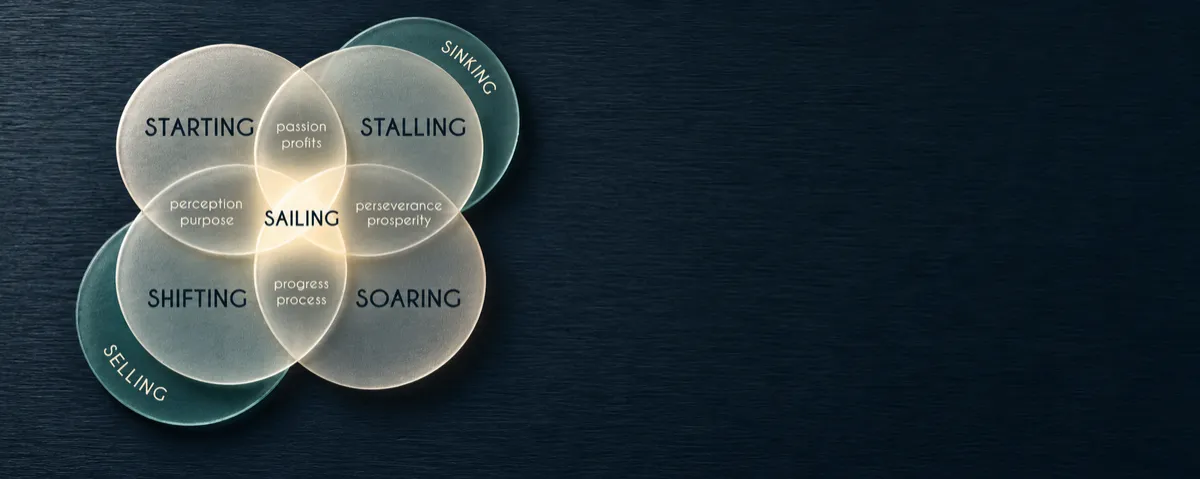
What Phase Is Your Firm In? Age and Revenue Lie
The misread I see most often starts with a decision nobody hears about. An owner decides the firm is going to change: a different kind of client, a narrower practice, a new way of taking on work. Intake gets rebuilt around it, a few people pick up different responsibilities, and the change never gets said out loud to the people who send the firm its work. Referral sources keep sending the old files, or quietly stop sending anything, and the team fills the silence with its own guesses. Then comes a quiet year, and the owner asks the question every owner eventually asks: what phase is my firm in? The two answers people reach for are how long the firm has been open and how much it brings in. Both of those lie. The firm in this story was changing course, and the quiet year was partly the cost of changing it in silence.
Business Growth Runs in Cycles, So Your Firm Can Be Here Twice
Most of the growth models owners run into draw a line. Larry Greiner's classic Harvard Business Review article on how organizations grow describes a series of phases, each ending in a crisis that forces the next. Neil Churchill and Virginia Lewis mapped five stages of small business growth, from simply existing through to maturity. Both got something important right: the problems of a firm change as the firm grows. The trouble is what a line implies to the owner reading it. If every firm should be further along each year, an owner in year twelve with the problems of year four concludes they failed.
I started building the 7Seas of Entrepreneurship in 1999 (it was only three Ps back then - Profit, Process, People) because I kept meeting owners who had reached that conclusion without having failed at anything. The framework treats business growth as seven recurring phases, which I call Seas. Firms return to the hard ones, often more than once, and they come back with better navigation rather than because they slipped backward. The numbering is a teaching order, not a sequence you march through. A firm can sit in two Seas at once, with one office growing while another stalls, or a new practice area starting up while the core business runs steady. That holds for an accounting practice or an agency as much as for a public adjusting firm or a first-party law firm.
Time isn't a diagnostic, either. Starting runs roughly two years. No other Sea has a typical length, because each one ends when conditions change, not when a calendar says so. How long you've been somewhere tells you nothing about whether you're still there.
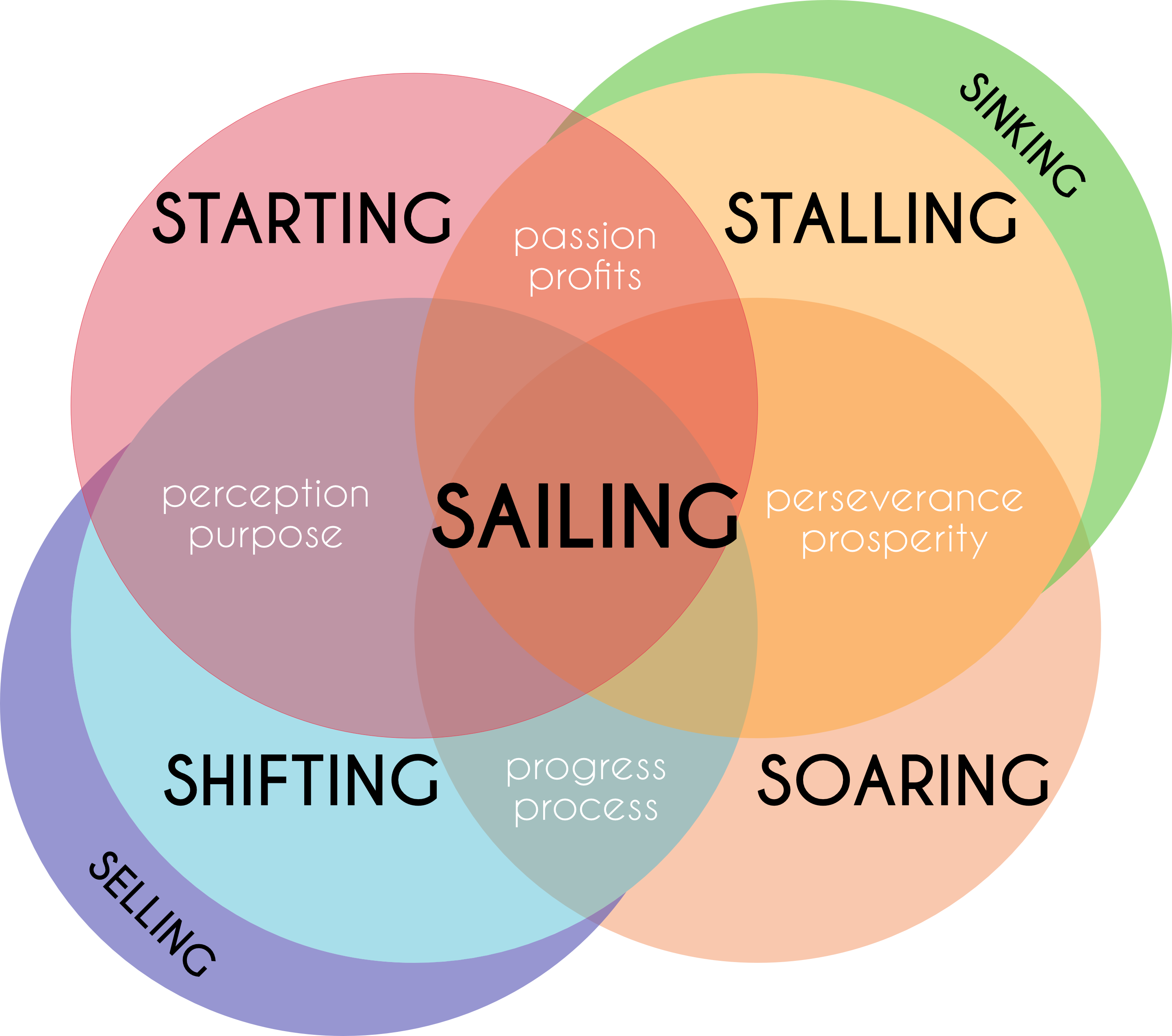
The Seven Seas, One Pass Through
Here's the whole map, with what each Sea is and what it tends to look like from the owner's chair.
Starting (Foundation): establishing purpose, first revenue, and first reputation. Revenue arrives in episodes, and pricing still comes with an apology.
Soaring (Growth): demand outruns capacity and momentum feels almost effortless. The owner's hours rise with income, and longtime clients start to notice the experience has changed.
Stalling (Power): growth levels off and the methods that always worked stop producing. Hours stay high while growth sits flat, sometimes for a year or more.
Sinking (Resilience): an outside shock strips the business down to what's essential. Revenue falls on a short timeline, and planning past this week stops being possible.
Shifting (Communication): a chosen change of direction, explained to everyone it affects. The current model still works but no longer fits, and the owner often describes the change privately long before announcing it.
Selling (Vision): preparing the firm for a sale, a successor, or a handoff to a leadership team. The owner finds themselves documenting things they've carried in their head for years.
Sailing (Integration): all eight elements of the business working as one system. The owner's hours fall while results hold.
One name needs a warning label. In the 7Seas framework, Selling means preparing the business itself for a transition. It has nothing to do with sales technique, pipeline, or closing, and an owner in the Selling Sea may never pick up the phone to a prospect. The other one worth flagging is Sailing, which sounds like a finish line and isn't. It's a phase like the others, and it can decay into Stalling when the owner stops paying attention.
The Eight Elements Every Business Runs On
Underneath the Seas sit eight elements that every business runs on, all of them present in every firm at all times. What changes from Sea to Sea is which four are carrying the load right now and which four matter less for the moment. Four are Foundation elements, which describe what the business is:
Purpose: why the business exists, used as a filter for real decisions
Passion: the fuel that keeps the owner and the team in the work
Perception: what clients, referral sources, and the market believe about you
Profits: pricing, margin, and cash
The other four are Operational elements, which describe how the business runs:
Process: systems, documentation, and delegation
Perseverance: the capacity to keep going under sustained pressure
Progress: measurement, and knowing whether motion is actually advancement
Prosperity: wealth beyond revenue, including an honest answer to how much is enough
The part a standard phase model can't give you is how these eight behave. They resolve into four permanent pairs that always move together. Drive is Passion and Profits, the fuel and the money. Direction is Purpose and Perception, where the firm is headed and how the market reads it. Endurance is Perseverance and Prosperity, the capacity to carry load and the depth of reserve behind it. Machinery is Process and Progress, the systems that turn effort into output and the measures that confirm it.
The pairs matter because owners try to fix one half of a pair on its own. When an owner's enthusiasm drops, revenue is already flattening or about to, so treating low energy and soft revenue as two separate problems means solving half of one. And you can't change what the firm is for without changing what the market believes about it. That second pair is the whole story of the quiet year.
Why Each Sea Feels the Way It Does
Two of the four pairs supply power: Drive and Endurance. The other two supply steering: Direction and Machinery. Each working Sea carries exactly two pairs, and the combination explains how the Sea feels better than any list of symptoms. Starting and Soaring carry one power pair and one steering pair, so effort and direction are both available at once. That's why owners remember those years fondly. Stalling and Sinking carry two power pairs and no steering pair, which feels like maximum effort with no change of direction. Shifting and Selling carry two steering pairs and no power pair, which feels like constant adjustment with nothing gained in speed. This is why a Shifting firm has a quiet year. It's steering, and steering doesn't produce speed. Sailing carries all four.
Inside each Sea, the two pairs play different roles. One pair does the work of moving the business, which I call the mainsail. The other shows the symptoms first, which is the headsail, because that's where trouble becomes visible before anywhere else. The pattern I see over and over is owners spending their energy on the pair that hurts, the headsail, and leaving the pair that would actually change things untouched.
Sea | Mainsail (moves the business) | Headsail (shows symptoms first) |
|---|---|---|
Starting | Passion + Profits | Purpose + Perception |
Soaring | Perseverance + Prosperity | Process + Progress |
Stalling | Perseverance + Prosperity | Passion + Profits |
Sinking | Perseverance + Prosperity, reduced | Passion + Profits, reduced |
Shifting | Purpose + Perception | Process + Progress |
Selling | Process + Progress | Purpose + Perception |
Sailing | All four pairs | All four pairs |
Four Questions That Tell You What Phase Your Firm Is In
Locating your firm takes four questions, asked in order. Each one narrows the field, and together they separate Seas that look alike from the inside.
Which elements are producing your symptoms?
Start with what hurts and match it to the pairs. If Passion and Profits are failing together, meaning the energy is gone and the revenue has flattened, you're looking at Stalling or Sinking. If Purpose and Perception are in question, meaning you're unsure what the firm is for or the market has stopped reading you correctly, you're looking at Shifting or Selling. This first question usually cuts seven possibilities down to two.
Is the change chosen or imposed?
Chosen change is Shifting. Imposed change is Sinking. This is the most useful single distinction in the framework, because the two call for opposite responses. An owner who decided to narrow the practice is Shifting, even if the quiet year that follows feels like a crisis. An owner who lost the practice area to a market change or a regulatory shift is Sinking, even if they're calling it a pivot to feel better about it.
Is effort producing motion?
Effort that produces no change of direction is the all-power rig of Stalling or Sinking: plenty of work, same place. Direction that changes without any gain in speed is the all-steering rig of Shifting or Selling. When effort and direction both show up, you're in Starting or Soaring, and you probably already knew it, because those Seas feel good.
Is the pressure light or heavy?
Stalling and Sinking share a rig, and so do Shifting and Selling, so the last question is about conditions. Flat and quiet is Stalling. Fast and failing is Sinking. For the steering pair, the question is whether you're changing what the firm is (Shifting) or preparing it to change hands (Selling).
Notice what isn't on the list. Time never appears, because apart from Starting, no Sea has a duration. These four questions locate the firm. Deciding what to do once you know where you are is the work that comes next, and it's different in every Sea.
Shifting and Selling: The Change Nobody Was Told About
Back to the quiet year. Shifting is the communication Sea, and its mainsail is Purpose and Perception. The story has to lead and the operation follows it: you restate why the firm exists and who it serves, you tell the people who need to hear it, and then you rebuild intake, roles, and measures to match. The owner in the opening did the reverse. The operation changed and the story never got told, so referral sources kept acting on the old story, clients wondered what happened, and the team filled the silence with guesses. To the market, a pivot nobody announced looks like drift.
Then comes the second misread. The owner sees the quiet year, decides the firm is Stalling, and pushes on the Stalling headsail: more marketing, a pricing change, a new referral campaign. All of that works on Passion and Profits, which weren't the problem. The pair that needed attention was Purpose and Perception, and the fix was a story nobody had heard yet.
Selling carries the same four elements with the lead reversed. Buyers and successors price the machine, so in Selling the operation leads and the story follows. The owner documents the work, builds measures that run without them, and proves the firm operates on its own, then positions the narrative for whoever takes it over. Owners who start a transition with the narrative end up with a story nothing supports, and due diligence finds the gap.
Stalling and Sinking: Same Four Elements, Opposite Answers
Stalling and Sinking carry the identical four elements, and confusing them is the most expensive mistake in the framework. Stalling is light air. Nothing is filling the sails, and the answer is more sail: more experiments, more risk, a willingness to try what the firm hasn't tried before. Sinking is a gale. The rig is close to failing, and the answer is to reef, which means deliberately carrying less canvas so the boat survives the wind and can still steer. The correct response to each is the exact reverse of the other.
Get it backward and the damage compounds. Cut back during a plateau, with a hiring freeze, a marketing cut, and a trimmed team, and the plateau becomes a permanent decline. Pile on during a crisis, with a new service line, a big marketing push, or any work at any price, and the extra load finishes the business. Owners make both mistakes for the same reason: they judge the Sea by how they feel, and both Seas feel terrible.
In a claims firm, the difference often looks like this, as an illustration. A quiet intake year after a busy storm season feels like a crisis and usually isn't. Revenue is down against an unusually strong comparison, the team has slack for the first time in months, and nothing structural has broken. That's Stalling, and it rewards experiment. Losing a major referral source and two senior people inside a single quarter is a gale, even if the revenue line hasn't moved yet, because the files still in the pipeline are hiding what's already gone. That's Sinking, and it rewards protecting cash and core capacity before anything else. The revenue number alone would have told the owner the opposite in both cases.
Knowing Your Sea Is Where the Work Starts
Naming the Sea changes which four elements get your attention next week, and that alone prevents the most expensive mistakes, including the quiet one this article opened with. It won't tell you what to do about it. The moves inside each Sea are different, and the order you make them in matters as much as the moves themselves.
The 7Seas assessment is the formal version of the four questions above, and it's the best next step if you read this and aren't sure which Sea you're in. If you already know, or the result surprises you and you want to talk it through, start with a discovery call with our team. We'll look at where the firm actually is, which pair is carrying the load, and what the next move should be.

This site uses graphics created using tools including ChatGPT and images sourced from Magnific under a commercial license.
All assets are used in accordance with their respective terms and licensing agreements.