
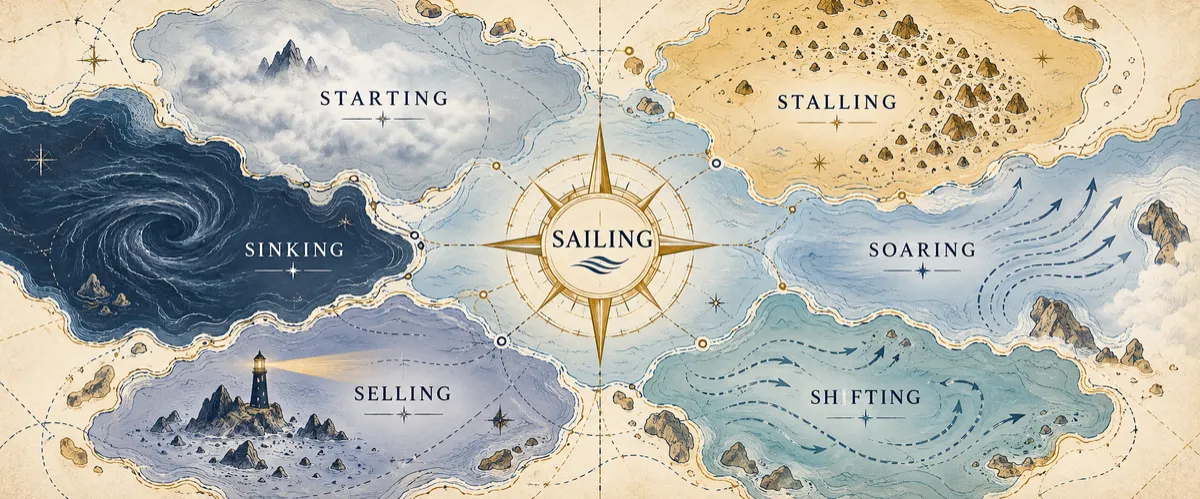
Survivorship Bias: Your Success Story Is a Sample of One
The owner on the conference stage built a firm that runs without them. They're invited to speak now, and afterward a line of younger owners wants a minute of their time, then a coffee, then a standing call. The story they tell is true. The room takes notes, and some of those owners will go home and try to run the same play. What nobody in that room sees is the owners who made the same moves in the same years and aren't in business anymore, because those owners don't get invited to speak. That's survivorship bias in business: drawing lessons only from the ones who made it. It travels fastest through the owners who have.
This is article seven of a series pairing each phase of the 7Seas of Entrepreneurship with the cognitive bias that shows up there most often, and it's the last of the seven pairings.
The Sailing Sea Comes With a Responsibility
The Sailing Sea is integration. All eight elements of the business work as one system, the owner's hours fall while results hold, and the firm no longer depends on the owner being in every decision. Mastery in this Sea isn't carrying every sail at once. It's knowing which sails to set and changing the configuration before the weather demands it.
The 7Seas framework attaches an obligation to this Sea, which I call the Captain's Responsibility. Success here creates a duty beyond your own firm: influencing the industry, mentoring other owners, and contributing to change past the business itself. That's a good obligation, and the industry is better when people who made it give back. It also carries a trap. The framework names the mistake that keeps owners stuck in Sailing as treating it like an endpoint, which lets the firm decay quietly into the Stalling Sea. Teaching your path as a fixed recipe is one of the ways that decay starts, in your own firm and in the firms of the people listening.
What the Research Says About Survivorship Bias in Business
The most famous survivorship bias story comes from World War II, and most retellings get it twisted. Statistician Abraham Wald worked with the Statistical Research Group at Columbia University on how to judge which parts of a bomber were most vulnerable to enemy fire. The only planes anyone could inspect were the ones that came back. Wald's insight was that the damage on returning planes only tells you where a plane can be hit and survive. To estimate vulnerability, his methods had to account for the planes that never returned and left no data behind. Statisticians Marc Mangel and Francisco Samaniego reconstructed his memoranda in the Journal of the American Statistical Association in 1984. The popular version, complete with a diagram of a bomber covered in red dots, is largely legend, as mathematician Bill Casselman lays out in The Legend of Abraham Wald for the American Mathematical Society. The real insight holds up fine without the embellishment.
The same thing happens with business data. In Survivorship Bias in Performance Studies, published in 1992, Stephen Brown, William Goetzmann, Roger Ibbotson, and Stephen Ross showed that studies of investment fund performance looked better than reality, because funds that closed simply dropped out of the data. Only the survivors were left to measure. An owner's own career works the same way. It's a dataset with one survivor in it.
What the Story on Stage Leaves Out
None of this means the owner on stage is wrong. It means the story can't contain the parts that matter most to someone trying to follow it. Across the owners I've watched teach from conference stages and in one-on-one mentoring, three things go missing most often.
The failures. The talk covers the decisions that worked. The ones that nearly sank the firm, the hires that went badly, and the years that went sideways get a sentence at most, because they don't fit the arc of a success story.
Who carried the firm. The owner's name is on the door, but behind most firms that reach the Sailing Sea are a handful of people who held it together: the operations lead who built the systems, the senior public adjuster or attorney who kept clients through a rough stretch, and the spouse or partner who covered the gap. From the stage, it sounds like one person's vision did it all.
Who helped them. Few owners mention the coach, advisor, mentor, or peer group that pushed them to make the hard calls. It's not modesty. Those conversations happened in private, so they don't feel like part of the story. But for the owner in the audience, knowing that the speaker had help is one of the most useful facts in the room.
Add those up and you get the real gap: the hard lessons that few people say out loud. Those are the lessons a younger owner most needs, and they're the first ones to get edited out.
There's an overlap worth naming, because it changes what you should watch for. In article five of this series, owners pivoted into new service lines based on a few success stories they'd heard. This is where those stories come from.
What the Hard Lessons Sound Like
The difference between a useful mentor and a misleading one usually isn't the quality of their success. It's whether they say the expensive parts. A useful mentor tells you what they'd do differently and what failed first. They name the people who carried the firm and the help they paid for. They're clear about what was timing, such as the market they built in or the state rules at the time, and what was a decision you could actually repeat. And they ask about your firm before telling you what worked for theirs.
For the owner listening, the question to carry into every conversation is simple: what happened to the people who tried this and didn't make it? If the person on stage can't answer that, you're hearing half the data.
What Sailing Looks Like When the Captain Stays Honest
The 7Seas framework describes an owner in the Sailing Sea as someone who can change the rig before the weather does. Owners who keep that skill while they mentor look different from owners who stop. They keep adapting their own firm instead of defending the version that worked. They can say which of their past decisions would fail in today's market. And the owners they mentor build firms that fit their own markets, rather than copies of someone else's.
That's the Captain's Responsibility done well: an owner who made it, telling the whole story, including the parts that don't make them look like they did it alone.
Seeing the Bias Is Free. Building Your Own Path Is the Work
Knowing about survivorship bias won't tell you which parts of someone else's story apply to your firm. Learning the principles that hold across firms, and building your own path instead of borrowing one, is what we cover in Below the Waterline, TAA's online course for owners who want a foundation built for their firm, not someone else's.
Next article, the series closes with a capstone that brings all seven biases together and shows why the 7Seas diagnostic questions catch what instinct misses.
Seven Seas Article Index
Sea | Bias | What it looks like in a firm |
|---|---|---|
Website content that never goes live because the owner imagines everyone judging it | ||
Growth vouching for systems nobody built, from how files are worked to onboarding | ||
Funding the tactic that used to work because a good stretch feels due | ||
The file that should have gone to an attorney and the lease signed to look bigger | ||
Pivoting into a new service line without asking anyone who might say no | ||
Pricing the firm off a conference multiple or a hot year, then taking the first offer | ||
Teaching from the one path that worked and leaving out the hard lessons |

This site uses graphics created using tools including ChatGPT and images sourced from Magnific under a commercial license.
All assets are used in accordance with their respective terms and licensing agreements.